Generative discovery research
An initiative focused on understanding expert workflows
Project Results and Outcomes
Established the first end to end understanding of editor workflows across Editorial Manager
Identified system level opportunities to reduce friction in high volume, expert workflows
Created research backed priorities for workflow simplification, automation, and navigation improvements
Laid the groundwork for modernizing a complex, legacy platform
Product context and problem
Editorial Manager is a 20 plus year old scholarly submission and peer review system with highly customizable and configurable workflows.
Over time, and without a dedicated design team, significant design debt accumulated, resulting in fragmented experiences across editorial tasks rather than cohesive end to end journeys.
As the first product designer on the platform, I led a year-long generative discovery research initiative to better understand editorial workflows end to end and to identify opportunities for future improvements.
Research Scope and Structure
Participants
40 editorial professionals
Editor in Chief, Managing Editor, and Associate Editor roles
A diverse group of multiple journal types, disciplines, and global regions
Methods
Generative interviews
Contextual inquiry
Live task walkthroughs
Workflow mapping
Cross-platform comparisons
Targeted usability evaluations
Focus Areas
Editorial triage
Post-review assessment and decision workflows
Reviewer invitation and management
System Navigation and job switching
My role
I led the initiative end to end, from research planning and facilitation through synthesis and stakeholder communication.
I partnered with a UX lead for recruitment and research operations, a junior designer for synthesis support, and two product partners from the parent company, including the Director of Product, who helped shape the scope of each phase.
Key Findings by Workflow Phase
Phase 1: Editorial Triage
How editors assess new submissions and decide whether to proceed
What we observed
Editors typically triaged submissions in batches to reduce context switching
Managing Editors handled administrative checks such as formatting, scope, and compliance but lacked efficient tools
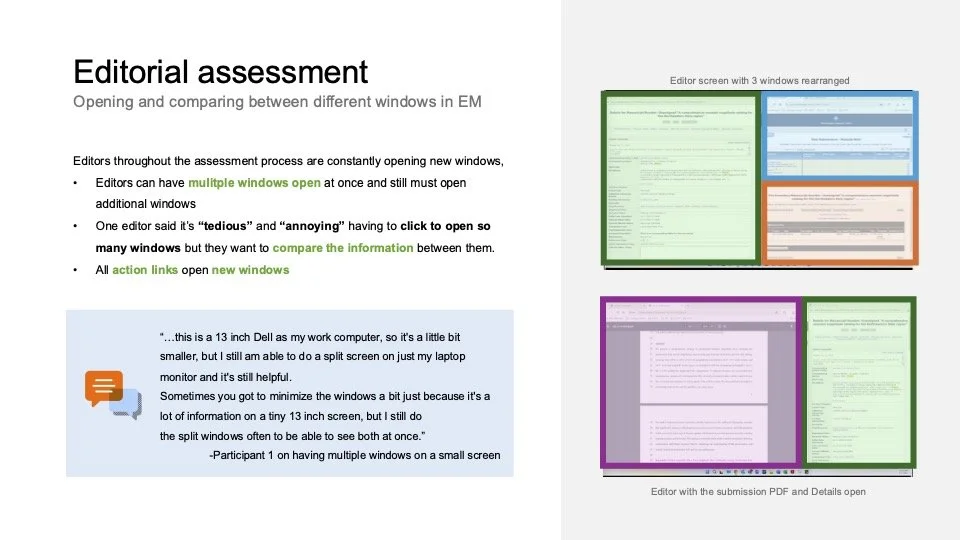
Editors opened 3 to 8 separate pages or windows per submission to complete a single assessment
Long, unsorted lists made assigning editors slower than expected
Confirmation steps and redundant actions added unnecessary clicks to otherwise simple decisions
Why it mattered
Early friction compounded quickly at scale, slowing decision making and increasing cognitive load in one of the highest volume parts of the workflow.
Phase 2: Post Review Assessment and Decision Work
How editors review feedback and complete formal manuscript decisions
What we observed
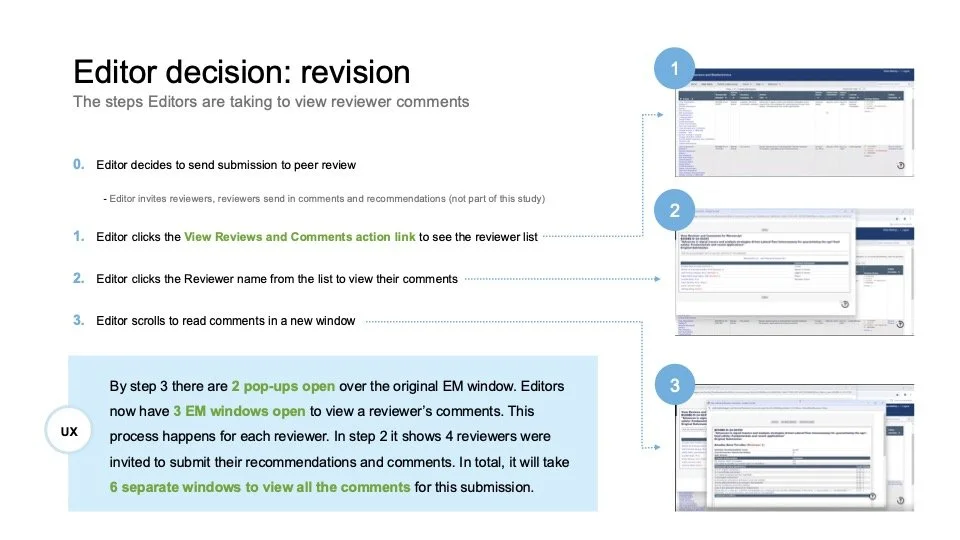
Viewing and comparing reviewer comments required up to 35 clicks per week per editor, over 1,800 clicks annually for a common task
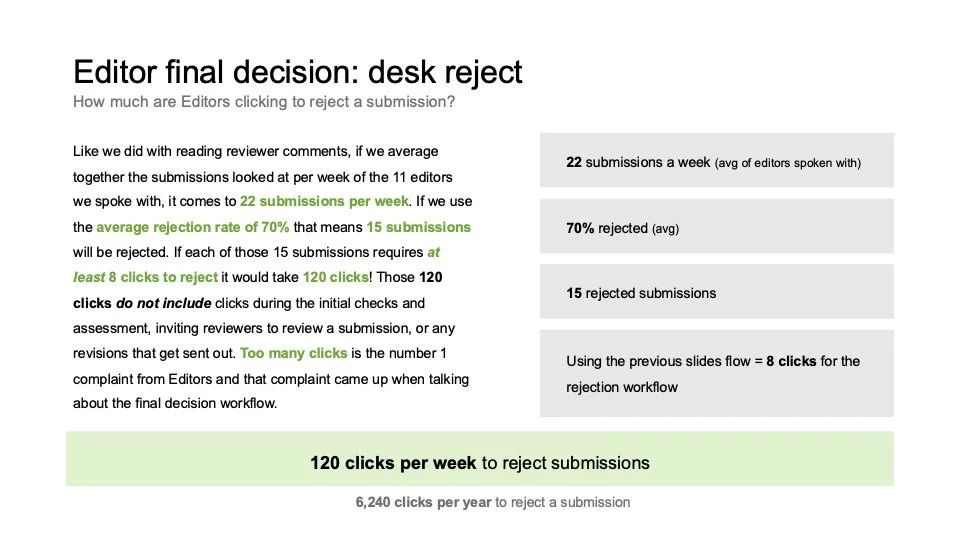
Desk rejections averaged roughly 120 clicks per week in the best case scenario
Editors reported that desk rejection was one of the highest volume decision paths, amplifying the impact of workflow inefficiencies
Decision terminology varied widely across journals, leading to inconsistent editor to author communication
Editors frequently drafted decisions in Word or Excel to manage clarity, reuse language, and reduce errors
Why it mattered
Click heavy and fragmented decision workflows slowed throughput, reduced confidence, and pushed editors to work outside the system for critical tasks.
Phase 3: Reviewer Invitation and Job Switching
How editors find reviewers, manage invitations, and move between editorial tasks
What we observed
Editors navigated 5 to 7 reviewer search options with unclear labels and inconsistent interaction patterns
Editors repeated searches across tabs to verify results, adding unnecessary steps
Assigning roles and customizing invitations required 15 to 25 clicks per reviewer, with no apply to all options
Key actions such as proceeding in the flow were placed far down the page, requiring excessive scrolling
Moving between submissions required returning to the main menu, breaking flow and increasing task switching
Why it mattered
Fragmented navigation and reviewer management workflows disrupted focus in high volume editorial work, increasing reliance on external tools and workarounds.
Outcomes & Impact
Established the first end-to-end understanding of editor workflows across the platform
Shifted roadmap conversations from isolated UI fixes toward system-level workflow improvements
Identified opportunities for workflow simplification, automation, and navigation redesign
Created research-backed priorities for reducing friction in high-volume expert workflows
Helped lay the foundation for modernization across a complex legacy system
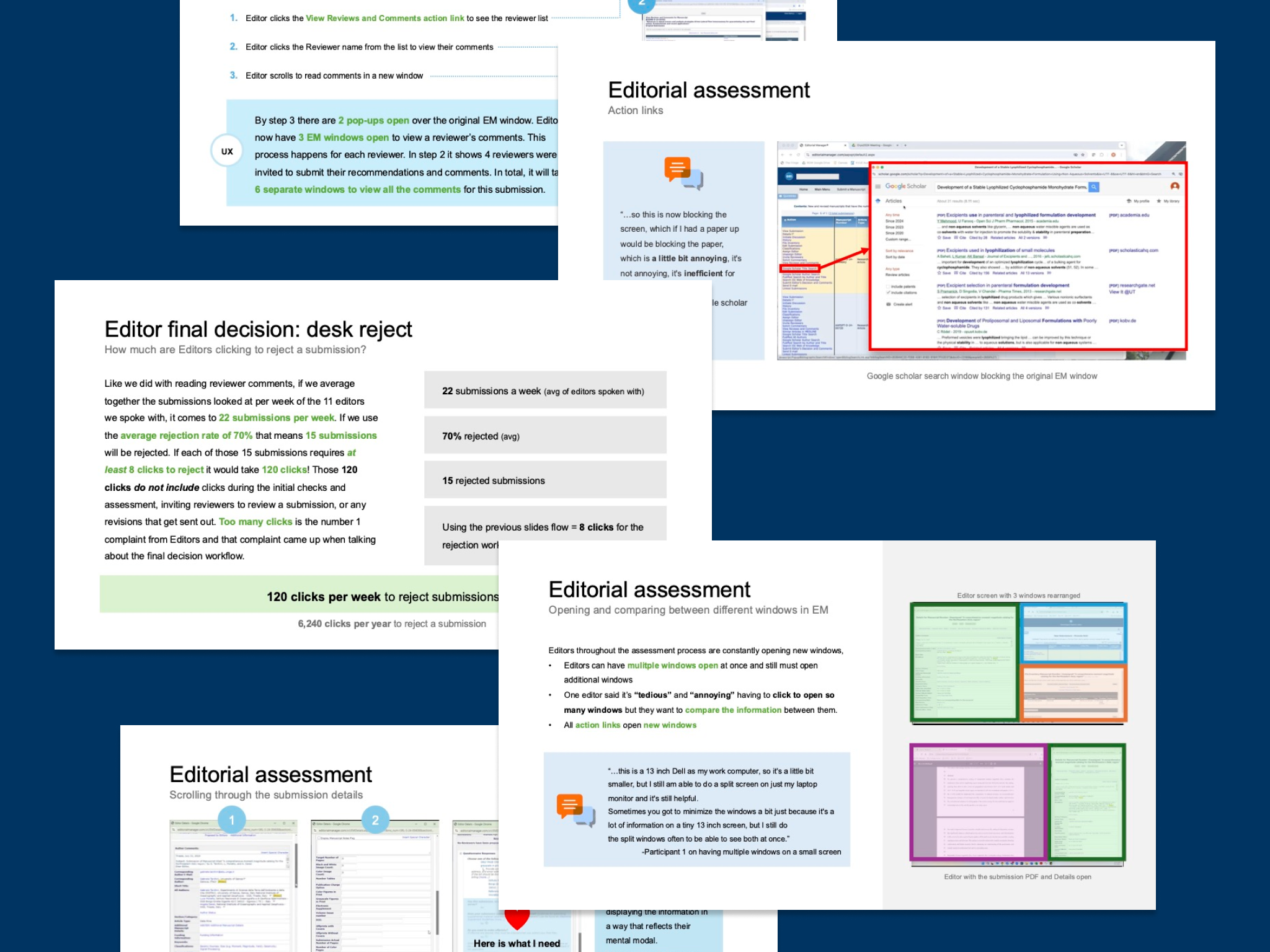
Examples of Slides from the Final Report